
Sometimes, you mention something during a webinar, and six months later, it appears in someone else’s article. This happened when I shared our approach to measuring RevLifter’s brand voice during a Wynter webinar.
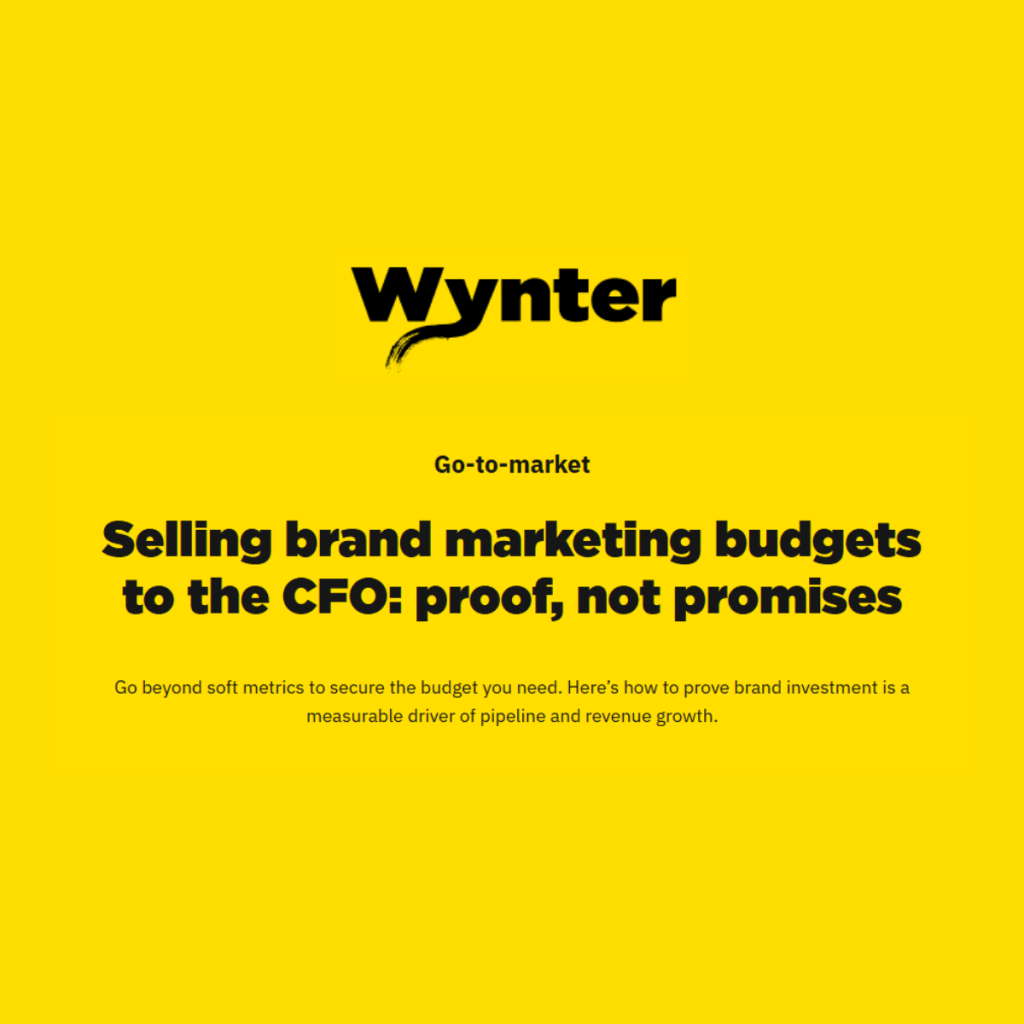
The mention appeared in their piece about selling brand budgets to CFOs:
Finally, commit to measuring and iterating. For example, RevLifter’s VP of Marketing Dan Bond shared how his team measures the impact of a bold brand voice using share-of-search and share-of-earned-media as affordable proxies – then watches how those metrics move customer acquisition cost and pipeline velocity over time. If share-of-search is rising but CAC isn’t falling yet, that might mean the payoff is coming later (lagging indicator), or it could signal a need to tweak messaging to better convert the new interest. Either way, you’re monitoring real data. The takeaway for the CFO: we will treat brand like an investment with KPIs and course-correct as needed, just as we do with performance campaigns.
Selling brand marketing budgets to the CFO: proof, not promises
The mention centres on something we’ve been wrestling with for a while: how do you prove brand marketing works when your CFO thinks in quarters, not decades?
Our solution became what Wynter called “affordable proxies.” We tracked share of search and share of earned media as leading indicators and watched how they influenced the metrics that actually matter to finance teams: customer acquisition cost and pipeline velocity.
Here’s the thinking: if our brand voice works, more people should search for us specifically rather than generic category terms. More industry publications should mention us in contexts we haven’t directly pitched for. These signals appear faster than revenue changes, giving us early warning signs about whether our brand strategy is building momentum or missing the mark entirely.
(It’s worth noting that “affordable proxies” sounds much more sophisticated than “metrics we can track very easily.”)
The fundamental insight isn’t in the metrics themselves—it’s in the connection between them. When share-of-search rises but CAC stays flat, that’s not necessarily failure; it might be a lagging indicator signalling future improvement. Or it could mean our messaging is generating interest but not converting intent. The data tells us which story is true.
We’re not claiming brand marketing is unmeasurable mystical art. We acknowledge that it operates on different timescales than performance marketing while still demanding evidence of its impact.
As Wynter framed it, the CFO takeaway is that we will treat the brand like an investment with KPIs and course-correct it as needed.
This is precisely how it should work—no mysticism, no “trust the process” hand-waving, just intelligent measurement that respects the complexity of brand building and the legitimate need for accountability.
The measurement challenge in brand marketing isn’t technical—it’s philosophical. Once you accept that brand building requires different metrics operating on various timescales, tracking becomes surprisingly straightforward. Like learning to cook, the most challenging part isn’t following the recipe; it’s understanding why the ingredients work together in the first place.ical—it’s philosophical. Once you accept that brand building requires different metrics operating on different timescales, the actual tracking becomes surprisingly straightforward.
Now, whether our approach actually works long-term? Ask me in eighteen months. The data will tell that story too.
This article was written with the assistance of AI.