The hurricane of 1812 had other plans for The Butcher’s Hall.
What had stood as the French Market’s main building since 1771—a Spanish-built structure where traders sold everything from fresh meat to exotic spices—lay in ruins along the Mississippi levee. The storm had swept through New Orleans like a particularly aggressive property developer, clearing the slate for whatever came next.
The following year, 1813, they rebuilt. Same location. Same basic structure. But something had shifted in the collective consciousness of New Orleans commerce.
By 1862, when someone (history has forgotten exactly who) opened the Original Cafe Du Monde Coffee Stand in that rebuilt market building, the lesson was clear: simple things survive storms better than complicated ones.
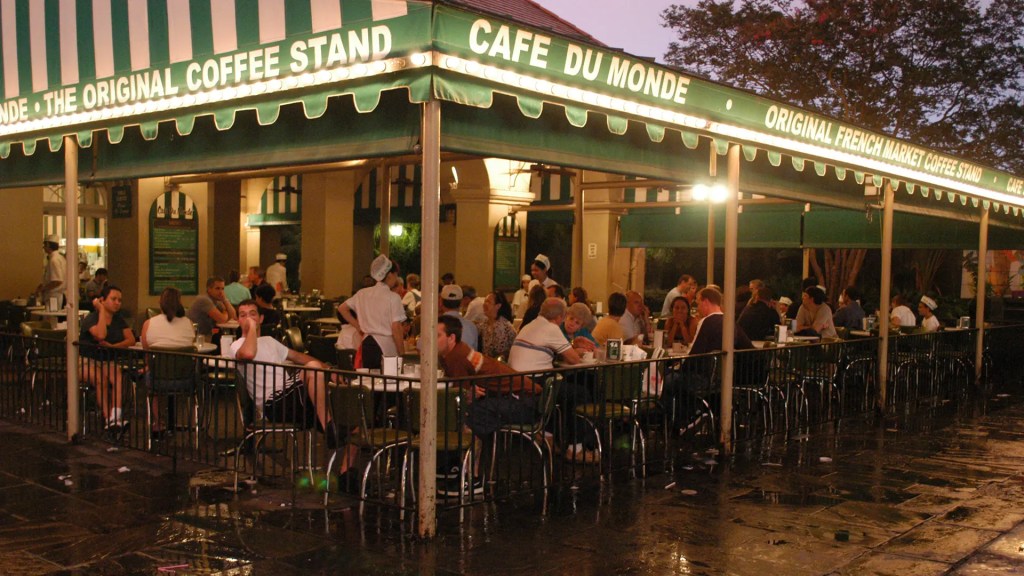
They served coffee with chicory. They served beignets. They served fresh orange juice and milk.
That was it.
While other establishments in the French Market expanded their offerings like enthusiastic pack rats collecting shiny objects, Cafe Du Monde kept their menu surgically simple.
(Even today, 160 years later, their menu consists of exactly seven items. Seven. Most modern coffee shops have more sandwich options than Cafe Du Monde has total products.)
The result? Every other business from that era is gone. Cafe Du Monde opens 362 days a year, closing only for Christmas and the occasional hurricane.
The storms taught them something about survival.
The Fernandez philosophy
In May 1942, Hubert Fernandez bought the coffee stand from Fred Koeniger. At the time, Fernandez owned the Fernandez Wine Cellar in the Pontalba Apartment building across the square—a proper business selling hundreds of wine varieties to sophisticated New Orleans palates.
Thirty years later, he closed the wine cellar to focus entirely on the coffee stand.
Think about that choice. Fernandez abandoned a business with infinite variety—French Bordeaux, Italian Chianti, California Cabernet, rare vintages, seasonal selections—to concentrate on a place that served coffee and beignets.
(Business schools would call this “portfolio rationalization through strategic divestiture.”)
The wine cellar required expertise in regions, vintages, storage, seasonal demand fluctuations. The coffee stand required expertise in exactly one coffee blend and exactly one pastry recipe.
Fernandez chose simplicity. His family still owns the place.
Meanwhile, how many wine shops from 1942 are still operating in New Orleans?
The mathematics of constraint
Modern businesses collect complexity like Victorian houses collect dust—slowly, inevitably, until the original structure disappears entirely.
Cafe Du Monde took the opposite approach. When iced coffee became fashionable in 1988, they added it. When customers demanded soft drinks, they obliged. But their expansion followed surgical precision, not shotgun enthusiasm.
Seven total menu items in 160 years. That’s one new offering every 23 years.
(Meanwhile, Starbucks introduces approximately 47 new drinks every Tuesday.)
This restraint creates operational superpowers. Their staff can perfect seven items to supernatural levels. A single server handles what requires three people at conventional restaurants.
Orders take thirty seconds. Preparation takes ninety seconds. Table turnover happens every fifteen minutes during peak hours.
Speed creates volume. Volume creates profit. Profit creates survival through hurricanes, pandemics, and the occasional existential crisis of modern commerce.
The mathematics are merciless. Add ten menu items, and complexity multiplies exponentially. Staff need training on new procedures. Inventory fragments across dozens of variables. Quality control becomes a bureaucratic nightmare involving multiple suppliers, preparation methods, and failure points.
Cafe Du Monde avoided this trap by treating menu expansion like nuclear weapons deployment—possible, but requiring extraordinary justification.
The chicory insight
Their coffee blend contains chicory, a root that was originally added during supply shortages. What began as wartime necessity became signature flavor.
This isn’t romantic New Orleans charm. It’s strategic differentiation through historical accident.
Every coffee shop in America can serve Colombian medium roast or Ethiopian single-origin. Only Cafe Du Monde serves their specific chicory blend, perfected over 160 years and served at precisely the temperature that complements hot beignets dusted with powdered sugar.
Try replicating that anywhere else.
(Go ahead. I’ll wait.)
Ryanair stumbled onto similar differentiation. Their no-frills approach wasn’t strategic vision—it was survival necessity during startup. But what began as cost-cutting became competitive advantage.
The pattern repeats: constraints become capabilities.
The hurricane test
Cafe Du Monde closes for hurricanes and Christmas. That’s it.
This policy reveals something profound about business resilience. They’ve survived the Civil War, two World Wars, the Great Depression, Hurricane Katrina, and a global pandemic by focusing obsessively on fundamentals.
While competitors expanded into catering, franchising, product licensing, and whatever other diversification strategies business consultants were peddling that decade, Cafe Du Monde served coffee and beignets to people sitting at their tables in New Orleans.
Everything else was someone else’s problem.
This discipline creates what strategists call “sustainable competitive advantage,” though that phrase sounds like it was invented by committee.
(It probably was.)
The real advantage is simpler: when you do one thing for 160 years, you become supernaturally good at it.
The modern application
Today’s businesses worship diversification like medieval peasants worshipped saints—with complete faith and no understanding of the underlying mechanics.
Basecamp built a project management empire by saying no to features competitors considered essential. While others added complexity like over-caffeinated developers at a hackathon, Basecamp perfected simplicity.
Their software does fewer things. But those things work reliably, which turns out to matter more than feature lists.
Tesla initially offered three car models: expensive, very expensive, and “perhaps we should auction our vital organs.” This constraint allowed them to perfect electric vehicle technology without serving every possible market segment simultaneously.
(Once they mastered the fundamentals, they expanded methodically. The Model 3 wasn’t their first car—it was their first affordable car after learning how to make cars that actually worked.)
The principle scales to any business. A marketing consultant focusing exclusively on conversion optimization for SaaS companies. A restaurant perfecting two signature dishes instead of offering mediocre variety. A retail store becoming the definitive source for one specific category.
Find your coffee and beignets. Everything else becomes optional.
Your strategic beignets
Every business has its coffee and beignets. The core offering customers can’t get anywhere else, executed better than anyone else can manage.
The question isn’t whether this capability exists. The question is whether you’re disciplined enough to strip away everything else that’s accumulated like barnacles on a ship’s hull.
Most aren’t. They’ll add one more product line, one more service offering, one more feature. They’ll convince themselves that complexity equals progress.
(It doesn’t. It equals expensive chaos with better PowerPoint presentations.)
Meanwhile, in New Orleans, a server places three beignets and cafe au lait in front of another delighted customer. He’s performed this exact motion roughly 50,000 times. He’ll do it 50,000 times more.
That repetition isn’t monotony. It’s mastery refined by hurricanes and perfected by time.
And that’s precisely why Cafe Du Monde will outlast today’s “innovative” restaurants with their seasonal menus, fusion concepts, and positioning strategies that change faster than Louisiana weather.
Pick your beignets. Perfect your beignets. Serve them through storms.
Perfect beignet recipe
(Sorry not sorry, Cafe du Monde)
Ingredients
- 1 cup water (exactly 110°F)
- 1 packet active dry yeast
- ½ cup granulated sugar, divided
- 1 large egg plus 1 egg yolk
- ½ cup evaporated milk
- 4 tablespoons butter, melted and cooled
- 1 teaspoon vanilla extract
- 4 cups bread flour
- 1 teaspoon salt
- Vegetable oil for frying
- 2-3 cups powdered sugar
Equipment
- Instant-read thermometer (water precision)
- Candy thermometer (oil precision)
- Large paper bag (sugar distribution)
Method
Proof the yeast Combine 110°F water, yeast, and 1 tablespoon sugar. Wait 10 minutes. Mixture should foam like enthusiastic cappuccino. If nothing happens, start over with better yeast or correct temperature.
Build the dough Add remaining sugar, eggs, milk, butter, vanilla to yeast mixture. Mix with dough hook. Gradually add flour and salt until soft, slightly sticky dough forms. (Think expensive modeling clay that hasn’t committed to its final form.)
First rise Place in oiled bowl. Cover. Rise 2 hours until doubled, or refrigerate overnight. (Cold fermentation develops superior flavor and makes Sunday morning assembly less frantic.)
Shape squares Roll dough ¼ inch thick. Cut into 2½-inch squares. Rest 10 minutes while oil heats.
Fry precisely Heat oil to 365°F. Fry squares in batches of 4-5, turning once, until golden brown (2-3 minutes per side). Transfer immediately to paper bag containing 1 cup powdered sugar. Shake vigorously.
Serve immediately Beignets are time-sensitive performance art. They exist in the brief window between fryer and consumption.
This article was written with the assistance of AI.