
In 1967, Britain had the largest electric vehicle fleet in the world. Not Tesla—Elon was probably still figuring out how to tie his shoelaces. Not some visionary tech startup with a name like “DisruptMilk” or “Dairy.ly”.
Milkmen.
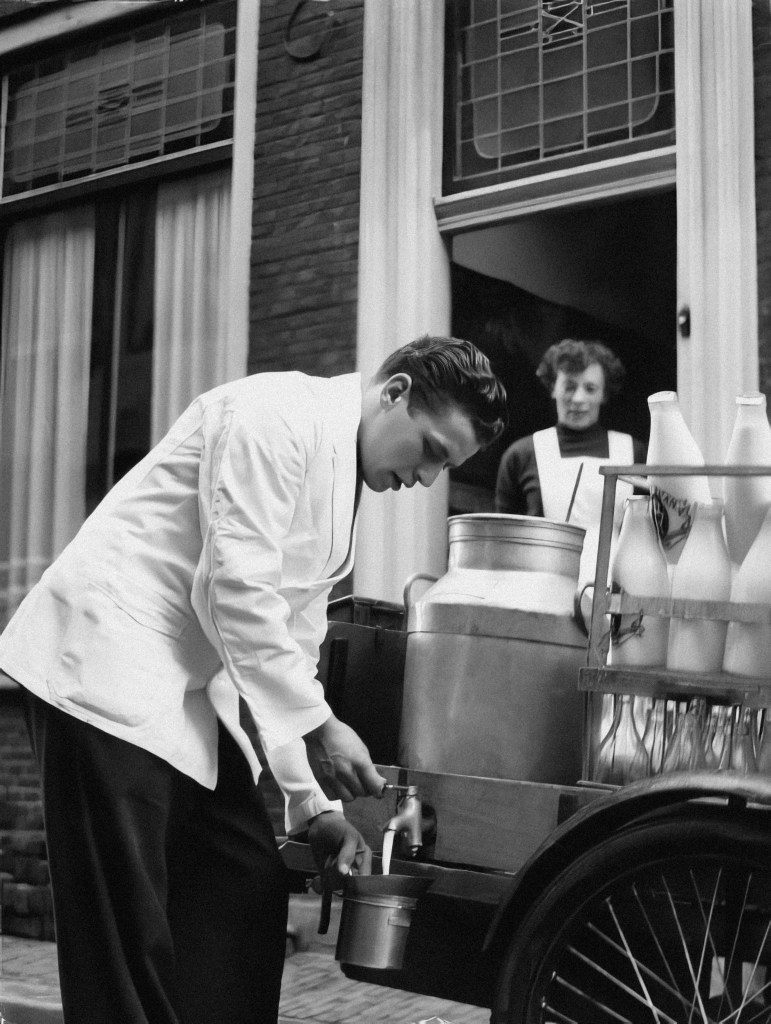
Thousands of them, humming through British streets in battery-powered floats that were quieter than a church mouse with social anxiety. Every morning, like the world’s most punctual army, delivering fresh milk in actual glass bottles that—and here’s the revolutionary bit—came back. By 1975, 94% of our milk arrived this way.
Then the 1990s happened.
(The 90s: when we collectively decided that convenience was more important than sense, Oasis was better than Blur, and frosted tips were a reasonable life choice.)
Supermarkets swaggered in with their plastic containers and seductive promises of convenience. “Drive to us!” they whispered. “Buy everything in one go! Forget about that charming chap who knew your preferred bottle count and whether you were going away for the weekend!”
So we dismantled the entire system for the privilege of driving to Tesco, queuing behind someone arguing about reduced-price bananas, and hauling home plastic bottles that would outlive us all.
Now, thirty years later, we’re calling the exact same thing “innovation.” It’s like watching someone reinvent the wheel and getting genuinely excited about their circular transportation breakthrough.
The plastic epiphany (or: when David Attenborough made us feel terrible)
When Blue Planet II aired in 2017, showing a pilot whale carrying her dead calf—poisoned by plastic pollution—something shifted in the British consciousness. Suddenly, that convenient plastic milk bottle felt about as appealing as a soggy biscuit.
(And if you’ve ever encountered a soggy biscuit, you’ll know that’s saying something quite profound about disappointment.)
Simon Mellin was one of millions watching, probably with a cup of tea and the sort of growing environmental guilt that only the British can perfect. Unlike most of us—who expressed our concern by tutting loudly and maybe switching to paper straws while continuing to live exactly as before—he actually did something about it.
In 2018, he founded The Modern Milkman with a mission borrowed directly from our grandparents: deliver fresh products in returnable containers. The revolutionary difference? An app instead of leaving a note in an empty bottle like some sort of dairy-based messaging system from the stone age.
(Though let’s be honest, there was something wonderfully analogue about leaving a note that said “2 pints please, Mr. Jenkins.” It was like texting, but with actual paper and the mild thrill of wondering if the milkman could read your handwriting.)
The timing was perfect. Or perhaps the timing was thirty years overdue, like a delayed train that’s been stuck behind a leaf on the tracks since Major was Prime Minister.
Following the money trail
The numbers tell a story of collective rediscovery that’s either heartwarming or completely mental, depending on your perspective. Home milk deliveries have climbed to about a million per day across the UK. That’s a million daily acts of beautiful regression, like an entire nation deciding that maybe the old ways weren’t completely barmy after all.
Steve Hayden of Parker Dairies picked up 100 new customers in 2018 alone, most specifically requesting glass bottles. “It takes them back to their childhoods,” he told Sky News, presumably while trying not to mention that their childhoods had superior environmental policies than their adulthhoods. [Which is like discovering your toddler has better financial planning than you do.]
But nostalgia alone doesn’t explain The Modern Milkman’s 1,000% revenue increase in 2020.
(That’s not a typo. One thousand percent. It’s the sort of number that makes business school professors weep with joy and accountants check their calculators twice.)
Something deeper was happening. Something that rhymes with “people suddenly realising that maybe driving to enormous sheds to buy milk in plastic containers wasn’t actually progress.”
The data from AHDB reveals the psychology behind this magnificent collective awakening. When consumers choose milk delivery, only 5% cite cheapness as a factor. Price ranks dead last, like being picked for sports teams in school.
(Remember that? The slow, humiliating shuffle of being neither first nor last but somewhere in that awkward middle where you’re not sure if you’re decent or terrible?)
Instead, 70% want to support local businesses—because apparently we’ve rediscovered that local businesses are run by actual people rather than algorithms with commitment issues. Another 54% value the convenience of not having to remember milk exists until you’re standing there with a cup of tea and the growing realisation that black tea is not, in fact, a lifestyle choice.
Environmental concern drives 32%, which sounds low until you remember that 32% of British people openly admitting they care about the environment is actually quite impressive. We’re not known for wearing our feelings on our sleeves, environmentally or otherwise.
This isn’t a purchase decision—it’s a values statement. Like choosing to queue properly or apologising when someone else bumps into you.
The subscription goldmine
What supermarkets missed, startups spotted with the sort of clarity that comes from not being massive corporate entities with the turning radius of oil tankers. The milk round isn’t just about milk—it’s about recurring revenue and expanding product lines. It’s subscription commerce that actually makes sense, unlike most subscription services that seem designed to make you forget you’re paying for them.
(Looking at you, Adobe Creative Cloud and your monthly guilt tax.)
The Modern Milkman’s customers don’t just buy dairy. They purchase bread, eggs, cleaning products, even wine. All delivered in returnable packaging, like Amazon Prime but with actual environmental credentials instead of vague promises about carbon neutrality by 2050.
The business model is beautifully simple, which is often the mark of genuine cleverness rather than the sort of complexity that makes consultants rich. Start with milk—the most regular grocery purchase, the one thing that runs out at the most inconvenient moments. Build trust through reliability.
(Show up when you say you will, don’t break the bottles, maybe remember that Mrs. Henderson goes away every third Thursday.)
Gradually expand the offering.
Create habits that stick like jam on fingers.
It’s subscription commerce disguised as tradition. Or perhaps it’s tradition that always understood subscription commerce, just without the venture capital and PowerPoint presentations about “customer lifetime value” and “market penetration.”
(Business phrases that sound vaguely inappropriate no matter how hard you try to make them sound professional.)
The technology edge
Modern milkmen face competition from three directions: supermarkets with their economies of scale and aggressive pricing, traditional local dairies with their authentic heritage and charming inefficiency, and each other with their apps and ambitions.
The winners distinguish themselves through technology and story, like contestants in a very specific sort of talent show where the prize is recurring revenue and customer loyalty.
The Modern Milkman invested heavily in customer-focused technology because they understood something crucial: in a world where we expect Amazon-level convenience, having to phone someone to change your milk order feels about as modern as using a rotary dial.
(Remember those? The sort of phones that required actual physical effort to make a call? Dark times.)
Their app lets customers add, remove, and pause deliveries with the ease of ordering a takeaway. Competitors still rely on phone calls and paper forms, which is charming right up until you need to pause your deliveries because you’re going on holiday and you can’t reach anyone because it’s Sunday and apparently dairy doesn’t work weekends.
But technology alone isn’t enough, because technology without purpose is just expensive showing off. The story matters more. Always has, always will.
Marketing to head, heart, and genitals
The most successful modern milk companies understand something that business schools teach but most businesses forget: they’re selling values, not vitamins. The Modern Milkman’s marketing hits what behavioural economists call the “head, heart, and genitals” approach
(And yes, that’s a real term. Economics is apparently much more interesting than anyone let on in school.)
Head: rational benefits like quality and convenience. The milk actually tastes better, arrives when promised, and you never run out at that precise moment when you need it most.
Heart: emotional benefits like supporting local farmers and reducing waste. Feel good about your choices while doing something your grandmother would approve of.
Genitals: status signalling—showing you’re the kind of person who cares about the planet and has the sort of lifestyle that includes regular milk deliveries.
(It’s virtue signalling, but the kind that actually requires commitment rather than just posting the right emoji on social media.)
Traditional competitors focus on family values and local heritage, which is noble but insufficient in a market where everyone’s competing for the same increasingly environmentally conscious pound. The Modern Milkman tells a different story about conscious consumption and environmental responsibility. They make customers feel smart and virtuous simultaneously, which is excellent marketing and probably good for society too.
Simon Mellin, the founder, embodies this narrative perfectly. He’s not just hiding behind a corporate structure like some sort of business-suited Wizard of Oz—he’s the face of change, the spokesperson for sustainable living. While competitors mumble about tradition and quality, Mellin talks about future and responsibility.
(And let’s be honest, if you’re going to revolutionise milk delivery, you might as well put your face on it. What’s the worst that could happen? Angry dairy farmers? Disgruntled supermarket executives? The wrath of Big Milk?)
The Benjamin Button business
This sector demonstrates what strategists call the “Benjamin Button effect“—businesses that get stronger as they age, but in reverse.
(Like Brad Pitt in that film, but with fewer existential crises and more dairy products.)
As modern milkmen sign more customers, they can invest more in quality, expand product ranges, reach new areas, and attract even more customers. It’s a virtuous cycle, like compound interest but with bottles.
Scale brings genuine advantages that would make any business professor slightly emotional. Larger delivery rounds reduce per-customer costs. Broader product ranges increase customer lifetime value.
(That’s the total amount a customer spends with you over their entire relationship, not their emotional worth as human beings, though that’s important too.)
Better technology improves retention rates.
The flywheel accelerates, momentum builds, and suddenly you’re not just delivering milk—you’re delivering a lifestyle.
But there’s a catch, because there’s always a catch. Growth requires capital, and delivery businesses burn cash like teenagers burn through mobile data. The Modern Milkman has raised significant funding, including backing from Insight Partners, because apparently even nostalgic businesses need venture capital these days.
They’re racing to achieve scale before running out of runway, which is the sort of high-stakes business drama that would make excellent television if anyone could figure out how to make milk delivery look exciting on camera.
The electric future
Here’s where it gets properly interesting: none of the major milk delivery companies has yet committed fully to electric vehicles. This represents both an enormous opportunity and an inevitable reality, like spotting a £20 note on the pavement that everyone else is somehow ignoring.
The original milkmen used electric floats because they were quiet, reliable, and perfect for stop-start deliveries. Modern electric vehicles offer exactly the same benefits plus environmental credentials that would make Greta Thunberg actually smile.
The company that moves first on electric delivery will own the sustainability narrative completely. It’s a differentiator just sitting there, waiting to be claimed like an unclaimed lottery ticket.
(And honestly, electric milk floats were probably the most sensible vehicles ever invented. Quiet enough not to wake anyone at 6am, reliable enough to work every day, and environmentally friendly decades before anyone knew that was supposed to matter. Our grandparents were accidentally brilliant.)
What we really learned
The milkman’s return teaches us something properly uncomfortable about progress, the sort of realisation that makes you question whether we’ve been doing this whole “modern life” thing correctly.
We had a functioning system of local delivery, electric vehicles, and reusable packaging. A system that worked, employed people, and didn’t slowly poison the planet.
Then we dismantled it for convenience, spent decades congratulating ourselves on progress, and are now desperately trying to innovate our way back to where we started. It’s like taking apart a perfectly good watch to see how it works, then spending thirty years trying to invent timekeeping.
Sometimes the future looks remarkably like the past, just with better apps and more venture capital.
The Modern Milkman and their competitors aren’t revolutionising grocery delivery—they’re demonstrating that some problems were already solved, sitting there patiently like well-behaved children, waiting for us to remember the solutions.
Perhaps that’s the most British innovation of all: improving something by making it exactly what it used to be, only slightly better and with more technology than strictly necessary.
(And if that’s not a metaphor for modern life, I don’t know what is. We’ve spent decades solving problems we created by solving problems that weren’t actually problems in the first place. At least the milk still tastes good. And you can get oat milk.)
The milkman cometh. Again. With an app this time.
This article is based on my submission for the final project for the Section Strategy course. AI helped me rework it into an article.